
How AI is reshaping supply chain roles, workforce requirements, leadership responsibilities, and talent strategies, and what organizations should do to prepare.
Supply chains have always evolved in response to new technologies, market disruptions, and changing customer expectations. Today, artificial intelligence (AI) and agentic AI represent another significant inflection point. These capabilities are no longer experimental; organizations are actively deploying them to improve planning, operations, and decision-making across the supply chain.
The challenge, however, extends beyond technology adoption. AI is changing how work is performed, how teams are organized, and which skills create value. Organizations that view AI solely as a software investment risk overlooking its broader implications for workforce strategy and talent development. AI changes the nature of work, the shape of teams, and the skills that matter.
The Digital Supply Chain Institute (DSCI) supports supply chain leaders through applied research and project-based learning. This paper examines how AI is reshaping supply chain roles, workforce requirements, leadership responsibilities, and talent strategies, and what organizations should do to prepare.
AI’s Impact on Supply Chains
The scale of investment in AI demonstrates the seriousness with which organizations are approaching this transformation. Industry forecasts suggest that AI-enabled supply chain software adoption will accelerate rapidly over the coming decade, supported by significant investments in digital infrastructure and enterprise capabilities.[1][2]
Many organizations report confidence in their AI strategies while simultaneously identifying significant skills shortages. This reflects a familiar pattern seen in previous technology shifts: companies are acquiring capabilities faster than they are developing the talent required to use them effectively. AI readiness and talent shortfalls can exist at the same time.[3]
The labor market further compounds the challenge. Demand for AI-skilled workers substantially exceeds available supply, and employees with AI-related expertise command significant wage premiums.[4] Relying exclusively on external hiring is unlikely to be sustainable. Developing internal talent, redesigning roles, and creating new learning pathways will increasingly become strategic necessities.
The Transformation of Roles and Organizational Structures
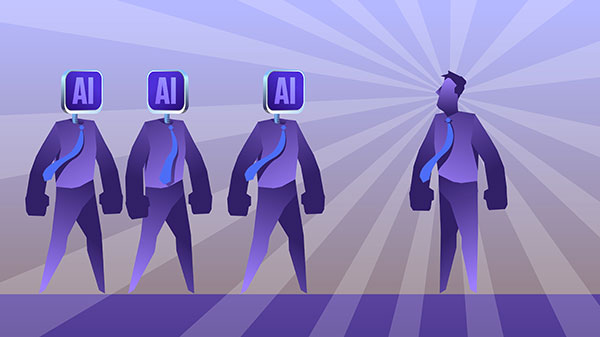
AI is changing supply chain work from the operational level upward, particularly by automating routine activities that historically justified entire tiers of the organization: analyst, coordinator, and managerial roles.
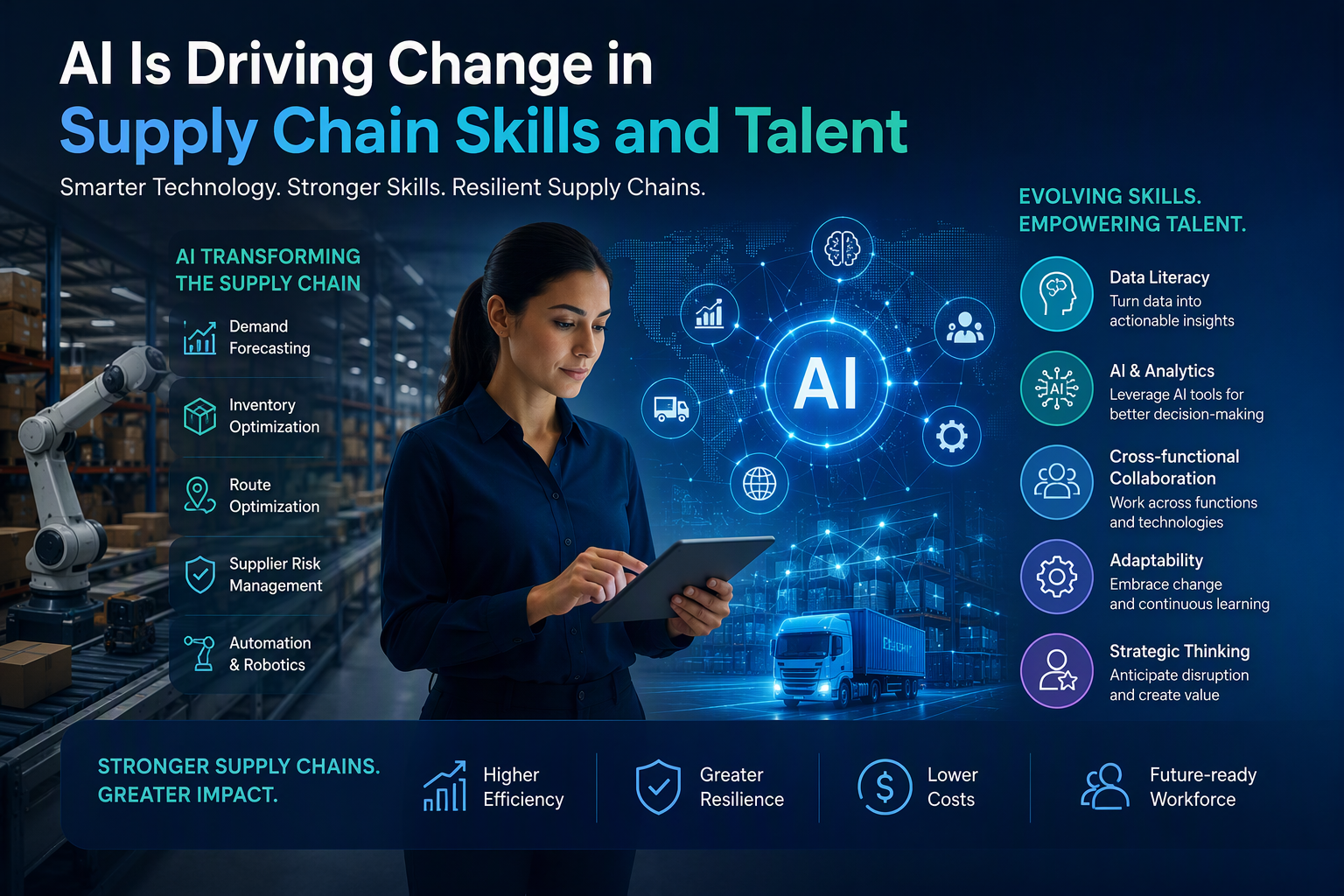
At the operator and analyst level, AI increasingly performs tasks such as inventory monitoring, exception detection, route analysis, and data preparation. Human workers remain essential, but their responsibilities are shifting toward judgment, oversight, and decision-making.
Examples from manufacturing illustrate this transition. BMW’s AI-supported quality systems and Siemens’ Industrial Co-Pilot demonstrate how organizations are retraining employees to work alongside AI technologies rather than simply replacing them. AI systems can identify potential defects or recommend maintenance actions, while trained employees evaluate recommendations, incorporate operational context, and determine the appropriate course of action.
The managerial layer may experience some of the most significant changes. AI is increasingly absorbing reporting, coordination, and information-processing activities that once occupied substantial portions of managerial work. The managers who create the greatest value in the future will lead mixed human-AI teams, establish governance frameworks, manage exceptions, and make decisions that require organizational judgment and accountability.
The opportunity is not to eliminate management but to redesign managerial roles around capabilities that technology cannot easily replicate: context, trust, trade-off decisions, and leadership during uncertainty.
Women, Talent Pipelines, and Workforce Equity
The workforce impact of AI will not be distributed evenly across organizations.
Women remain heavily underrepresented in executive leadership positions in supply chain organizations.[5] At the same time, research consistently highlights the importance of capabilities such as judgment under ambiguity, cross-functional collaboration, communication, and change leadership, areas in which many women already demonstrate considerable strengths.[6]
Organizations must ensure that women are actively included in AI implementation initiatives, leadership development programs, and emerging technical and governance roles. Without deliberate action, companies risk concentrating women in functions undergoing rapid change while limiting participation in the positions shaping future supply chain operations.
Managing this transition effectively is both a workforce issue and a strategic talent imperative.
Building an AI-Ready Culture
Regardless of role or seniority, employee perceptions of AI significantly influence adoption outcomes.
Workforce anxiety, uncertainty about changing responsibilities, and concerns about job security can slow implementation efforts and reduce organizational effectiveness. Studies suggest that employees who view AI as an opportunity rather than a threat are more likely to engage productively with new tools and processes.[7]
Transparent communication about how roles will evolve, what skills will be valued, and how employees will be supported through change is essential. Organizations that actively engage employees in the transition are more likely to realize the benefits of AI investments than those that treat workforce concerns as secondary considerations.
Strategic Actions for Supply Chain Leaders
DSCI recommends four actions for chief supply chain officers and senior leaders.
Conclusions and Recommendation
The organizations that thrive during this transition will not necessarily be those with the most sophisticated AI technologies. They will be those that pair technological advancement with deliberate workforce transformation.
Four priorities stand out.
First, leaders must treat AI as a workforce challenge as much as a technology initiative. Investments in tools without corresponding investments in people will deliver limited returns.
Second, organizations must redesign, not simply preserve, early-career pathways so future leaders develop the skills required to operate in AI-enabled environments.
Third, companies should ensure that women and other underrepresented groups participate fully in AI implementation, governance, and leadership opportunities. Inclusive talent strategies will strengthen both innovation and resilience.
Fourth, middle management will be critical to a successful implementation of AI tools. They should be trained on how to lead mixed AI and human-led teams and how to address concerns held by those within their team.
Over the coming months, supply chain leaders should assess which roles are changing most rapidly, establish clear ownership for workforce transformation initiatives, and invest in the capabilities that will define success in an AI-enabled future. The organizations already doing this are pulling ahead. The window to close that gap is narrowing.
- Morgan Stanley, AI Infrastructure Investment Forecast Through 2028 (2025). Morgan Stanley estimates that global spending on AI infrastructure will reach approximately $3 trillion by 2028, driven by investments in data centers, semiconductors, cloud computing, and enterprise AI deployment.
- Gartner, Future of AI-Enabled Supply Chain Management Software Market, 2025–2030 (2025). Gartner forecasts that the AI-enabled supply chain software market will reach $53 billion by 2030, with 60% of enterprises using AI-enabled supply chain management tools, up from just 5% in 2025.
- Gartner and Randstad, The Gen Z Workplace Blueprint: Future Focused, Fast Moving (2025). While 83% of organizations describe themselves as AI-ready, 47% identify AI skills as their largest workforce capability gap, highlighting a growing disconnect between technology ambition and talent preparedness.
- PwC, Global AI Jobs Barometer 2025 (June 3, 2025). PwC found that workers with AI-related skills earned an average 56% wage premium in 2024, up from 25% the previous year, demonstrating the growing market value of AI expertise across industries.
- Gartner and AWESOME, 2025 Gartner/AWESOME Women in Supply Chain Survey (May 2025). The survey found that women comprise 41% of the overall supply chain workforce but only 31% of leadership roles.
- Inc., “Women Have the Skills AI Can’t Replace, According to a Wharton Neuroscientist” (June 2026). Citing research by Wharton neuroscientist Michael Platt, the article argues that women tend to score highly on communication, creativity, perspective-taking, and decision making under pressure, capabilities that remain difficult for AI systems to replicate.
- Wang, Xu, Hu, and Liu, “Opportunity and Threat: How Employees’ Perceptions of Artificial Intelligence Influence Job Crafting,” Baltic Journal of Management 20, no. 4 (2025). The study found that employees who viewed AI as an opportunity engaged in more job crafting behaviors, although these positive effects diminished when AI was also perceived as a threat.
This article by the Digital Supply Chain Institute first appeared in Supply Chain Management Review as AI is driving change in supply chain skills and talent.