|
|
Signals & Shifts
|
The Brief
A defining supply chain question is emerging: How do we build the talent and organizational structures needed for a future shaped by AI, automation, and constant change?
Accenture projects that U.S. supply chains will need 1.34 million additional workers by 2035, while the labor market is expected to add only 221,000. KPMG reports that 77% of supply chain leaders already face talent shortages.
|
1.34M
ADDITIONAL WORKERS
NEEDED BY 2035
|
|
77%
OF LEADERS FACE
TALENT SHORTAGES
|
|
14%
FEEL VERY PREPARED
FOR AI IMPACT
|
For me, the opportunity extends beyond filling open positions. It is about redesigning how work gets done by bringing together intelligent systems, human judgment, and customer needs within one unified operating model. Technology can absorb more routine tasks, allowing people to focus on decision-making, relationship building, trade-offs, creativity, and leadership. Future value will come from how well organizations orchestrate both human and technological capabilities.
This shift will fundamentally change how we develop talent. Skills must evolve through practical learning, access to leaders, mentoring, and opportunities to apply new capabilities. Our latest TrailblazeHERS research reinforces the urgency of this challenge: only 14% of respondents feel very prepared for the impact AI and machine learning may have on their careers.
These questions will be central to discussions at our 13th DSCI Executive Leadership Forum in Tokyo, October 14–16. In partnership with CGE and IHG, we will convene leaders from organizations including ICC, Kuehne+Nagel, IBM Japan, Samsung SDS, SoftBank, Microsoft, NTT, Amazon Business, Allcargo and Li & Fung.
The program will bring together diverse perspectives on geopolitics, digital trade readiness, emerging technologies, trusted and secure AI-ready supply chains, and creating customer value and trust. We will connect DSCI research with hands-on operational learning, and what organizations are experiencing across industries and geographies.
After the Tokyo forum, we will translate these learnings into practical approaches that help our community develop talent, redesign work, and strengthen future operating models. This is how research becomes shared learning, and shared learning becomes action. It is how we prepare people and supply chains to become integral components of tomorrow’s intelligent enterprises.
We move on together.
— Marko
|
|
|
|
Ilya Levtov
Founder and CEO, Craft
|
For Craft, focusing on the government and defense sector earlier this year, has unquestionably been the right move. Rising defense spending is creating pressure to vet and monitor the defense supply chains at greater speed and scale. At the same time, a stream of new supply chain legal mandates is elevating the requirement for continuous supply chain screening and monitoring. Recent examples include the Executive Order: Securing America’s Defense Supply Chains and Ensuring Domestic Acquisition of Critical Materials, as well as the and the Department of War (DoW) formal notifications to 30 domestic academic institutions directing them to conduct immediate and comprehensive reviews of their academic, financial, and research collaborations with foreign entities of concern. Both developments occurred within the last two months. Yet many organizations still rely on manual, low-fidelity processes to meet these requirements.
|
|
|
DSCI HIGHLIGHTS
|
Welcome, Kuehne+Nagel
The Digital Supply Chain Institute (DSCI) is pleased to welcome Kuehne+Nagel, one of the world’s leading logistics providers, as its newest member. As a global leader in transportation and logistics, Kuehne+Nagel brings deep expertise and a shared commitment to advancing more resilient, transparent, and digitally enabled supply chains. DSCI is excited to collaborate with Kuehne+Nagel on several strategic initiatives, including the 30-Day Research Sprint, the Constellation of Value (CoV) framework, and supply chain resilience efforts. Together, DSCI and Kuehne+Nagel look forward to driving research, innovation, and practical solutions that strengthen global supply chains in an increasingly complex and interconnected world.
|
|
|
The After-Sales Relationship Is Going Digital
Our recent research sprint on customer engagement across the automotive, luxury, and consumer sectors highlights a shift the automotive industry can no longer ignore: customers increasingly expect to manage every aspect of vehicle ownership from their phones. From charging and fueling decisions to service scheduling, software updates, and repair estimates, the traditional model, where the dealership served as the primary post-sale touchpoint, is being replaced by a continuous digital relationship.
The companies retaining customers most effectively are not necessarily those with the most sophisticated apps. They are the ones delivering reliable, trusted experiences through accurate service estimates, relevant notifications, and dependable recommendations. Loyalty programs can strengthen these relationships by rewarding behaviors such as proactive maintenance or efficient charging with benefits that extend across a broader ecosystem of services and partners. However, rewards only create value when the underlying digital experience is trusted.
This shift also has significant implications for the after-sales supply chain. Demand increasingly begins as a digital signal generated by vehicle data or customer behavior rather than a visit to a service center. Parts forecasting, technician scheduling, warranty management, and repair planning must all become more predictive and data-driven. As loyalty ecosystems expand to include charging providers, repair networks, and other partners, every participant must deliver a consistent experience. The leaders in customer retention are treating the app, partner ecosystem, and supply chain as a single, integrated operating system.
|
|
Executive Leadership Forum
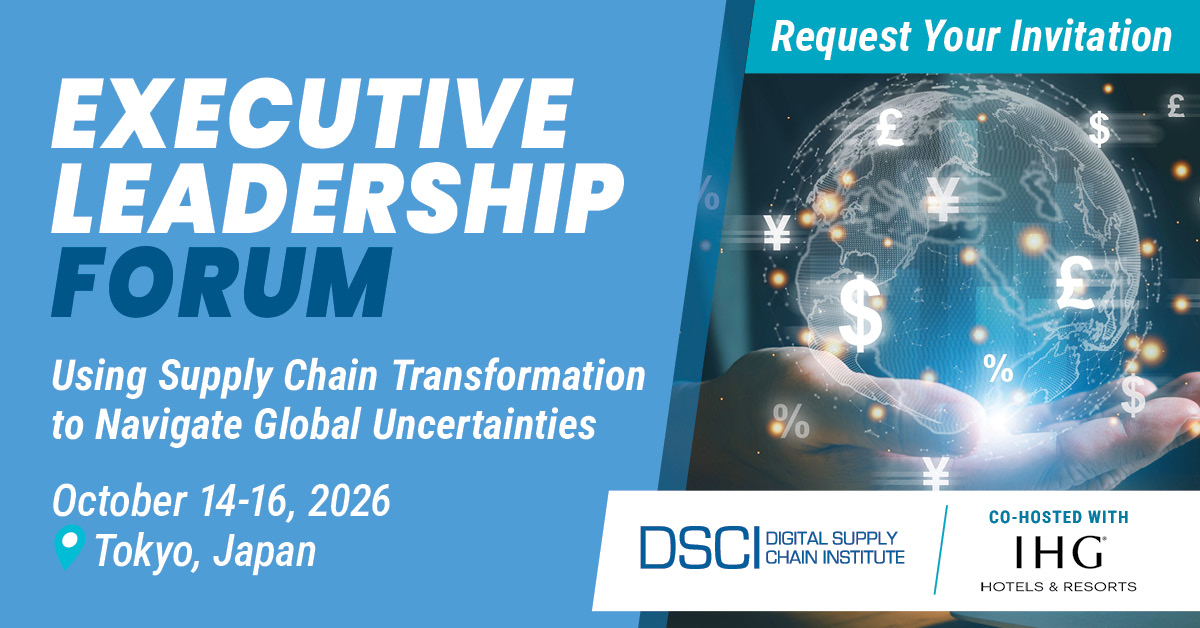
Last call to join DSCI’s 13th Executive Leadership Forum at the ANA InterContinental in Tokyo, October 14 – 16. This private, invitation-only event, hosted in cooperation with our member IHG, will convene C-level supply chain leaders under the theme “Using Supply Chain Transformation to Navigate Global Uncertainties.”
The Forum will explore how leading organizations are adapting to AI deployment, shifting trade dynamics, emerging regulatory constraints, and growing demands for resilience.
|
Reducing Friction in Global Trade
A pilot involving 20 companies from across the global supply chain revealed important insights into where organizations excel, where they face challenges, and why digital trade capability maturity is a critical driver of both operational efficiency and security.
|
“
While discussions about digitizing global trade workflows often focus on operational efficiency and cost reduction, the real value of digitalization goes much deeper.
— CRAIG MOSS AND VIVEK GHELANI, DSCI
|
|
Help Shape the Future of Digital Trade Readiness
The ICC Digital Standards Initiative (ICC DSI), together with the British Standards Institution (BSI) and the Digital Supply Chain Institute (DSCI) and ICC Germany is exploring the next phase of the Digital Trade Readiness Assessment (DTRA), an initiative designed to help organizations assess and demonstrate their readiness to participate in digital trade ecosystems.
As part of this effort, the ICC will convene a roundtable of banks and financial institutions to discuss the opportunities and challenges associated with digital trade adoption and to help shape the future direction of the initiative.
| SEPTEMBER |
| 22 |
| 9:00 AM ET • VIRTUAL |
|
|
Virtual workshop for banks and financial institutions. Additional workshops for logistics providers and manufacturers will be announced in the coming months.
|
|
BASC World Congress
Marko recently moderated a panel session at the 12th BASC World Congress in Miami, on “Securing Every Shipment, Verifying Every Delivery: Responsibility, Security, and Trust for the Global Supply Chain.” The session was sponsored by BigBear.ai. Joining Marko on the panel:
|
Mario E. Pérez Balladares E.
President, Panama Transshipment Group (PTG), Narval Holding Corp.
Ryan Rawding
Vice President of National Security, BigBear.ai
Eddy Dolan
Managing Partner, International Shipping Compliance (ISC) and former DHS Regional Attaché for Central America
|
The panelists explored how traceability, data analytics, and advanced technologies are transforming risk management while strengthening confidence in international logistics operations.
|
ASCM CHAINge 2026
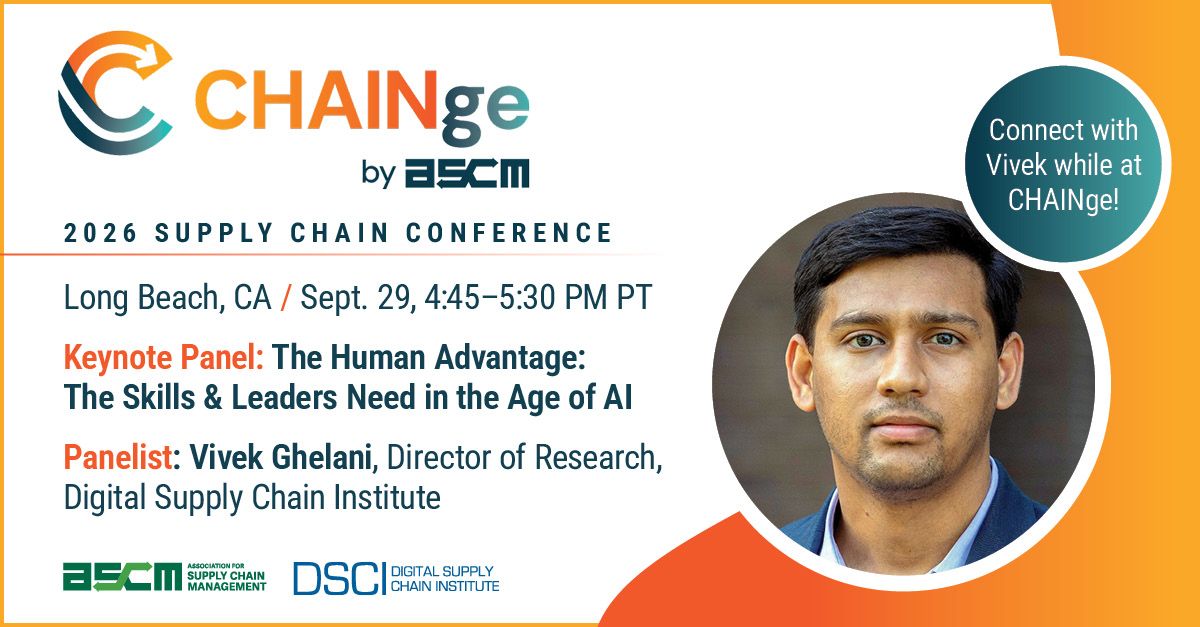
DSCI’s Director of Research, Vivek Ghelani, will be taking the stage at ASCM’s CHAINge 2026 (Sept. 29–30, Long Beach) for a keynote panel called “The Human Advantage.”
He’ll unpack:
| • |
How supply chain roles are shifting as AI scales |
| • |
What leadership looks like when change is constant |
| • |
Ways to attract, upskill, and empower talent in high-stakes environments |
|
The Reading List
|
SUPPLY CHAIN BRAIN
North American companies ordered 17,995 robots valued at $1.166 billion during the first half of 2026. Unit orders increased 2%, while order value rose 6.6%, driven largely by a 35% surge in semiconductor/electronics orders, according to the Association for Advancing Automation data.
|
|
HARVARD BUSINESS REVIEW
Retailers should operate as platforms, shifting inventory, merchandising, and pricing responsibility to brands through store-in-store and agency models while focusing their own efforts on curating the customer experience, governing the ecosystem, and building traffic. As AI makes consumer demand more transparent, price-sensitive, and unpredictable, platform-based retail models may become an important source of resilience and competitive advantage.
|
|
SUPPLY CHAIN BRAIN
Organizations need mechanisms that not only identify hidden liquidity within the business but enable capital to be deployed rapidly in response to changing business conditions.
|
|
CNBC
Shipping authorities from 18 countries have warned that diverging rules and sanctions-evasion networks could contribute to the emergence of a fragments, two-tier maritime trading system.
|
|
|
SIGNALS & SHIFTS
Get this in your inbox each month
Subscribe to receive DSCI research, member news, and the reading list.
|
|
Regards,
Digital Supply Chain Institute
|
Copyright © 2026 Digital Supply Chain Institute. All rights reserved.
Digital Supply Chain Institute || Center for Global Enterprise, 745 5th Ave, Suite 500, NY, NY 10151
|
|